
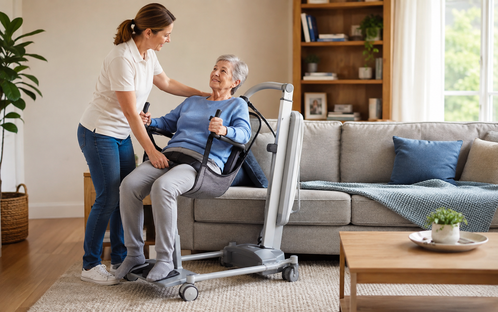
Trying to lift a heavy person from the floor by yourself can injure both you and the person who fell. If they cannot get up safely, avoid pulling them by the arms, shoulders, clothing, or waist. Check for possible injury first, then decide whether they can move with guidance or need appropriate lifting equipment.
For family members, caregivers, or anyone who may need to assist someone with limited mobility, a floor lift chair or full-body patient lift can reduce the need for direct manual lifting. The right option depends on whether the person can sit upright, bear weight, reposition themselves, and tolerate a sling transfer.
What Should You Check Before Helping Someone Off the Floor?
Do not make getting the person upright the first priority. After a fall, spend a few moments checking what happened, how the person feels, and whether moving them could make an injury worse.
Signs of Injury
Look for pain, swelling, bleeding, obvious deformity, or new difficulty moving an arm or leg. Possible injury to the head, neck, back, or hip needs particular caution. Confusion, loss of consciousness, unusual drowsiness, vomiting, new weakness, or new problems speaking or seeing also require urgent medical attention.
If you suspect a serious injury, keep the person as comfortable as possible and contact emergency services rather than trying to lift them. In the United States, call 911 when emergency help is needed.
Movement and Response After the Fall
Ask simple questions before moving the person:
- Where does it hurt?
- Did you hit your head?
- Can you move both arms and legs?
- Can you roll or shift position comfortably?
- Do you feel dizzy, weak, or confused?
- Do you think you can sit upright?
Someone who is alert, comfortable, and able to reposition may need a very different recovery method from someone who cannot move independently.
Level of Assistance Needed
If the person can get up independently after checking for injury, let them move slowly and use a stable support. Guidance for self recovery generally involves rolling onto the side, moving onto hands and knees, using stable furniture for support, bringing one foot forward, and rising gradually before sitting down to rest.
If they cannot complete those movements, do not try to make up the difference by lifting more of their body weight yourself. A mechanical lift may be appropriate only when it has already been selected for that person and the caregiver knows how to use it safely.
How Can You Safely Lift a Heavy Person Off the Floor?
The safer approach is to move the person's weight with equipment rather than asking one caregiver's back, arms, and knees to carry it. Health and care settings commonly use floor recovery hoists, lifting cushions, slings, and other transfer equipment for this reason.

Use a Floor Lift Chair
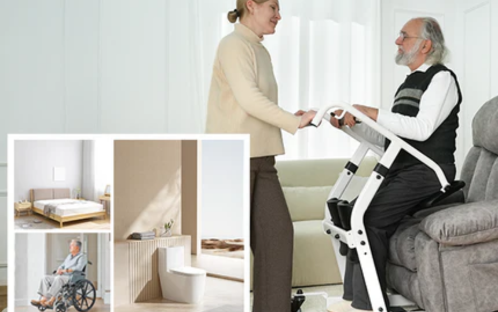
A floor lift chair can work well when the person has no obvious injury, can remain seated with appropriate support, and does not require a sling around the entire body.
The VOCIC AX08 Electric Chair Lift lowers close to floor level and electrically raises the user to a seated transfer height. Its powered lifting action means the caregiver does not need to pull the person upward by hand. The chair supports up to 300 lbs, uses a hand controller, folds for storage, and has an adjustable backrest that changes position as the seat rises.
This type of device is useful when a person ends up on the floor but can still tolerate a seated position. Once safely positioned on the chair according to the manufacturer's instructions, the user can rise gradually rather than attempting one difficult movement from floor level to standing.
The 300 lb capacity is an important limit. A person and any items supported by the device must remain within the manufacturer's rated capacity. If more complete body support is needed, or the person's weight exceeds the chair's limit, a full body lift may be more appropriate.
Use a Hoyer Lift
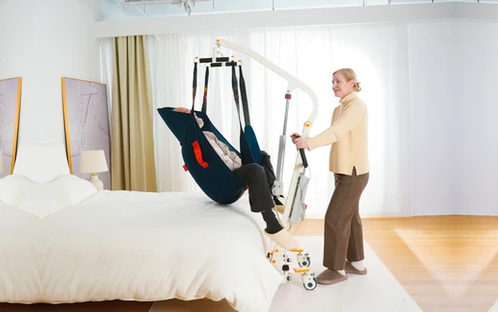
A full body Hoyer lift serves a different purpose. It supports the person in a sling and allows the lift to carry their weight when they cannot reliably stand, bear weight, or maintain the seated position needed for a floor lift chair.
The VOCIC AY02 Electric Hoyer Lift has a 440 lb capacity and is designed for floor recovery as well as transfers between locations such as a bed, wheelchair, and toilet. Its adjustable base ranges from 24 to 34 inches, and the unit includes manual emergency lowering if powered lowering is unavailable.
The sling is especially important for someone who needs support around more of the body. Sling type, size, attachment points, and positioning must match both the user and the lift. A sling that is too large, too small, attached incorrectly, or incompatible with the hoist can create a fall risk.
A Hoyer lift should not automatically be considered a one-person device. Some transfers can be completed by one trained caregiver, while other users and transfer situations require two or more people. The person's care plan, professional assessment, and manufacturer instructions should determine how many caregivers are needed.
How Do You Choose Between a Floor Lift Chair and a Hoyer Lift?
Both devices can reduce manual lifting, but they support very different levels of mobility. Start with what the person can safely do rather than choosing only by price or maximum capacity.
Ability to Sit and Bear Weight
A floor lift chair is generally better suited to someone who can sit upright and maintain a reasonably stable seated position after the fall.
A Hoyer lift is more appropriate when the person cannot safely bear weight, has much less trunk control, or needs their body supported during the entire lift.
Type of Transfer Needed
A floor lift chair mainly solves the problem of raising someone from a very low position to a practical seated height.
A Hoyer lift can support a wider transfer sequence. Understanding what a Hoyer lift is can help caregivers choose the right equipment for transfers between the floor, bed, wheelchair, or other suitable surface.
Body Support Needed
A lift chair supports the user through the seat and backrest. The person must therefore be able to remain appropriately positioned on the chair.
A Hoyer lift uses a sling to support much more of the body. This makes sling selection and positioning critical, especially for users with poor trunk control or very limited ability to assist with the transfer.
Weight Capacity
Always compare the user's weight with the rated capacity before using any lifting device.
The VOCIC AX08 is rated for 300 lbs, while the VOCIC AY02 is rated for 440 lbs. Never exceed the stated limit, and remember that higher capacity alone does not make a device appropriate for a particular person or transfer.

What Should You Check Before Using a Lift Alone?
Owning a mechanical lift does not automatically make every floor recovery safe for one caregiver. The user, equipment, environment, and transfer method all need to be appropriate.
Follow the Manufacturer's Instructions
Learn the full lifting process before an emergency occurs. Know how the controls, locks, emergency lowering function, sling attachments, and other safety features work.
Health and safety guidance recommends introducing moving and handling equipment only after assessment and using it according to the person's care plan and the manufacturer's instructions.
Check the User's Position
Before lifting, confirm that the person's body is properly positioned and supported for that specific device.
During the lift, watch for sliding, leaning, trapped arms or legs, pain, or a sudden change in alertness. Stop if the person's position becomes unsafe.
Clear Enough Space for the Lift
Remove loose rugs, bags, furniture, cords, and other obstacles. A mobile Hoyer lift needs enough floor space for its base and wheels to move into the required position.
Difficult surfaces and incorrect hoist movement can increase the risk of tipping, so the floor and surrounding space matter.
Secure the Sling or Seat
For a Hoyer lift, use the correct sling type and size and attach every required loop or clip exactly as instructed. Check the sling for damage before use.
For a floor lift chair, confirm that the user is centered and adequately supported before raising the seat.
Never leave a vulnerable person unattended while they are suspended in a hoist or positioned where they could fall.
Keep an Emergency Backup Plan
Know what you will do if the lift loses power, the user becomes uncomfortable, or the equipment cannot complete the transfer.
A backup plan may include the lift's emergency lowering procedure, a second trained caregiver, a personal alarm, or emergency medical services. The AY02, for instance, includes a manual emergency lowering function.
Conclusion
If a heavy person cannot get off the floor, avoid trying to manually lift their full body weight alone. Check for injury first, then use a properly selected lifting device when it is safe to move them. A floor lift chair can suit someone who can remain seated and needs help rising from floor level, while a Hoyer lift provides fuller body support for someone who cannot reliably bear weight. Whichever device is used, stay within its weight capacity, follow the manufacturer's instructions, and make sure one person operation has been assessed as safe for that particular user and transfer.
FAQ
What Should You Do If You Can't Get Someone Off the Floor?
Do not keep pulling or lifting if the person cannot get up safely. Check for pain or injury, keep them comfortable and warm, and seek appropriate help. If serious injury is possible or the person cannot safely be moved, contact emergency services. For people who fall repeatedly, a healthcare or rehabilitation professional can assess whether floor recovery equipment should be available at home.
How Can an 80-Year-Old Get Up Off the Floor?
Age alone does not determine whether someone can get up independently. If there is no suspected injury and the person feels able, they can move slowly onto their side, then onto hands and knees, approach a stable piece of furniture, bring one foot forward, and rise gradually before sitting and resting. Someone who cannot safely complete these movements should call for help rather than repeatedly attempting to stand.
Can You Lift Someone Off the Floor With a Towel?
A towel should not be used as an improvised lifting sling. It can slip, provides limited body support, and still requires the caregiver to take much of the person's weight manually. Even purpose designed handling belts are intended to assist people who can support their own weight rather than to lift them from the floor. Use appropriate floor recovery equipment instead.
What Do Nursing Homes Use to Lift Patients?
Care facilities may use mobile hoists, floor recovery hoists, standing hoists, full body slings, lifting cushions, transfer boards, slide sheets, and other equipment selected for the resident's needs. The appropriate device depends on the person's ability to bear weight, body support needs, transfer task, and care plan.
Share:
Travel Tips for Senior Citizens: How to Travel Safely and Comfortably
Bathroom Safety for Elderly: How to Make a Bathroom Safer