
Moving someone between a bed, wheelchair, toilet, or chair can place both the caregiver and the person at risk if the technique does not match the person’s abilities. Safe transfer techniques for caregivers begin with assessment, preparation, clear communication, and the right level of assistance.
The safest method is not always the one that uses the least equipment. It is the method that allows the person to participate without losing balance while protecting the caregiver from lifting more weight than they can safely control.
Choose the Transfer Technique by Mobility Level
Before approaching the bed or chair, determine how much of the movement the person can complete safely.
Ask whether the person can:
- Sit upright without falling sideways
- Move toward the edge of the bed or chair
- Place both feet securely on the floor
- Bear weight through one or both legs
- Push up with the arms
- Stand long enough to turn
- Follow simple instructions
- Report pain, dizziness, or weakness
The answers help determine which technique and transfer aids may be appropriate.
|
Mobility level |
Possible transfer technique |
Assistance required |
|
Can stand, balance, and turn safely |
Independent or supervised transfer |
Observation or light guidance |
|
Can bear some weight and follow directions |
Stand-pivot transfer |
Hands-on assistance, a gait belt, or an appropriate sit-to-stand device |
|
Has good sitting balance but cannot stand safely |
Sliding-board transfer |
Board placement, stabilization, and guided seated movement |
|
Cannot bear weight or maintain safe sitting balance |
Mechanical full-body lift |
Compatible lift and sling operated by trained caregivers |
Treat this assessment as current only for that transfer. A person who completed a stand-pivot transfer yesterday may be weaker after illness, medication, poor sleep, or prolonged sitting. If their knees buckle, their balance changes, or they cannot follow instructions, stop and choose a more supportive method.
Prepare the Person, Equipment, and Environment
Good preparation removes avoidable hazards before either person begins moving.
Explain where the person is going and how you will help. Use short instructions such as, “Move forward,” “Place your feet flat,” and “Stand when I count to three.” Confirm that the person is alert and willing to participate.
Ask about pain, dizziness, shortness of breath, fatigue, recent surgery, and movement restrictions. Check the care plan for weight-bearing limits, weaker limbs, joint precautions, medical tubing, or prescribed transfer equipment.
Prepare the destination before starting:
- Place the wheelchair, chair, or commode close to the starting surface.
- Clear rugs, cords, footrests, and clutter from the route.
- Set both surfaces at compatible heights when possible.
- Apply wheelchair brakes and move footrests aside when the chosen method requires it.
- Make sure the destination will not slide or tip.
- Put nonslip footwear on the person.
For a safe bed-to-wheelchair transfer, the chair is usually positioned close to the person’s stronger side unless the care plan specifies another arrangement.
Protect your own body as well. Stand close, keep your feet apart, bend at the hips and knees, and keep your spine in a comfortable neutral position. Move your feet when turning instead of twisting your torso. Do not pull on the person’s wrists, underarms, clothing, or neck.
A gait belt may provide a controlled handhold for someone who can bear weight and participate. It is not a handle for lifting a fully dependent person. Avoid placing one over abdominal surgery, an ostomy, feeding tubes, painful ribs, or fragile skin unless a qualified professional has approved its use and shown you the correct placement.

Perform a Stand-Pivot Transfer Safely
A stand-pivot transfer may be suitable when the person can sit upright, bear weight through at least one leg, follow instructions, and remain standing long enough to turn.
Use the following sequence:
- Move forward. Help the person bring their hips toward the edge of the bed or chair. Their feet should rest flat on the floor, slightly behind the knees when possible.
- Position yourself. Stand close with a stable base. If a gait belt is appropriate, hold it from the sides or back using the grip taught during training.
- Lean forward. Ask the person to bring their nose over their toes. This moves their center of gravity forward before standing.
- Stand together. Count aloud so the movement is coordinated. The person should push from the bed or armrests rather than pulling around your neck.
- Pivot with small steps. Keep the person close and turn by moving your feet. Do not plant your feet and twist at the waist.
- Back up to the destination. Continue until the person can feel the seat against the backs of their legs.
- Lower slowly. Ask them to reach for the armrest or surface when safe, bend their hips and knees, and sit under control.
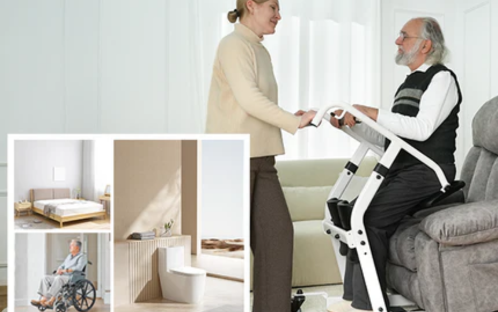
For someone who retains partial leg strength but needs more structured support, the VOCIC AY03 PRO Sit-to-Stand Lift Assist supports weight-bearing users during short seated transfers. Its 400-pound capacity, padded multi-point support, dual-lock braking system, and split-seat design can reduce the physical effort involved in moving between compatible surfaces.
A sit-to-stand device still requires active participation, sufficient trunk control, and the ability to maintain the posture required by the equipment. It is not a substitute for a full-body lift when the person cannot safely support weight.
Use Seated and Sliding-Board Transfers Correctly
A sliding-board transfer allows a person to move laterally while remaining seated. It may be useful for someone with good sitting balance and upper-body control who cannot stand safely.
Position the wheelchair or destination surface close to the starting point, preferably at a slight angle. The surfaces should be level or arranged so the person moves slightly downward rather than uphill. Lock the wheelchair and move the nearest armrest and footrest out of the way when their designs permit it.
Help the person lean away from the direction of travel. Place one end of the board securely under the upper thigh or buttock and the other end firmly on the destination surface. Avoid placing the board against bare skin or trapping fingers beneath it.
Ask the person to move across in several small lifts or scoots. The caregiver can stabilize the knees, guide the hips, or support balance according to the care plan, but should not drag the person across the board. Pause if the board shifts, the receiving surface moves, or the person begins sliding forward.
Once the hips are fully supported by the destination surface, remove the board carefully and restore the armrest, footrests, cushions, and positioning supports.
In situations requiring powered height adjustment or movement between compatible home and vehicle surfaces, the VOCIC AY06 Electric Transfer Lift offers a 330-pound capacity, adjustable height, and a foldable frame. Its base is designed to slide beneath compatible vehicle chassis, but caregivers must measure the available clearance and confirm seat, doorway, floor, and vehicle compatibility before purchase or use.

Use a Mechanical Lift and Respond to Unsafe Transfers
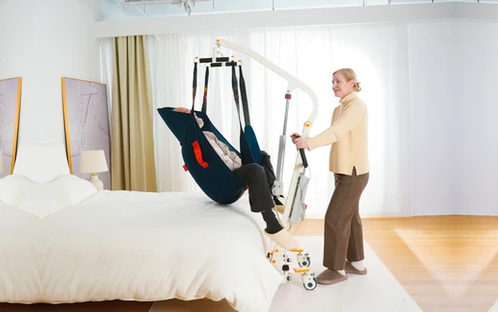
A mechanical full-body lift is generally the safer choice when the person cannot bear weight, cannot maintain the posture required for a stand-pivot transfer, or becomes unpredictable during manual movement.
Before using one, confirm that:
- The lift can support the person’s weight
- The sling type, size, and attachment style are compatible
- The sling has no tears, stretched loops, or damaged stitching
- The battery or hydraulic system works correctly
- The route and destination are ready
- The required number of trained caregivers is available
Place the sling exactly as its instructions describe. Connect each loop to the designated attachment point and remove slack gradually. Raise the person only an inch or two at first, then stop to check the sling position, connections, comfort, and body alignment.
Keep the person only as high as necessary to clear obstacles. Guide a floor-based lift using its push handles, not the boom, spreader bar, sling, or the person’s body. Caster and brake procedures differ between models and stages of a transfer, so follow the specific manual rather than applying one universal rule. The complete process for using a patient lift safely also requires hands-on training in sling placement and emergency procedures.
For users who need full-body support, the VOCIC AY02 Upgrade Foldable Electric Patient Lift has a 440-pound capacity and a base that adjusts from 24 to 34 inches. Its folding design may simplify storage, while manual emergency lowering provides a backup if powered lowering becomes unavailable. The sling and lift limits must still be checked separately because the lowest-rated component determines the safe working capacity.
Know When to Stop
End the transfer immediately if the person:
- Cannot bear the expected amount of weight
- Develops sudden pain, dizziness, or shortness of breath
- Becomes confused, frightened, or unable to follow directions
- Starts sliding from the bed, chair, board, or sling
- Shows knee buckling or an unexpected loss of balance
Also stop if equipment moves, tilts, makes an unusual sound, or does not respond correctly.
If a fall begins, do not twist or jerk upward in an attempt to hold the person’s entire weight. If you have been trained to do so, guide them toward the nearest safe surface or floor while protecting their head. Check for pain, bleeding, confusion, deformity, or a possible injury to the head, neck, spine, or hips. Seek emergency help when an injury is suspected or the person cannot be assessed safely.
A failed transfer is a reason to reassess the method, not simply to try harder. Consider changes in strength, cognition, pain, equipment, surface height, staffing, and the care plan before making another attempt.
Final Thoughts
Safe transfer techniques for caregivers depend on matching the method to the person’s ability at that moment. Use a stand-pivot technique only when the person can participate and bear weight, choose a sliding board when controlled seated movement is appropriate, and use a full-body lift when manual support is insufficient. Equipment from VOCIC can support different mobility needs, but no transfer device replaces an individualized assessment, hands-on instruction, and the operating manual for the exact model.
FAQ
What Is the Safest Way to Transfer Someone From a Bed to a Chair?
The safest method depends on the person’s weight-bearing ability, sitting balance, cognition, pain, and care plan. A stand-pivot transfer may suit someone who can participate, while a sliding board or mechanical lift may be safer when standing is not possible.
When Should a Caregiver Use a Gait Belt?
A gait belt may be appropriate when the person can bear some weight and follow instructions but needs controlled balance support. It should not be used to lift a fully dependent person or placed over contraindicated medical sites without professional approval.
Can One Caregiver Perform a Transfer Alone?
Sometimes, but only when the person’s assessment, care plan, equipment instructions, and facility policy permit it. A second trained caregiver may be needed for poor trunk control, unpredictable movement, complex medical equipment, or difficult positioning.
What Should a Caregiver Never Do During a Transfer?
Never pull someone by the arms, underarms, wrists, clothing, or neck. Do not lift dead weight manually, twist while supporting the person, use damaged equipment, exceed weight limits, or continue after balance or equipment control has been lost.
How Often Should Transfer Ability Be Reassessed?
Assess the person before every transfer. A formal reassessment may also be necessary after a fall, hospitalization, medication change, new pain, illness, surgery, or noticeable change in strength, balance, cognition, or cooperation.
Share:
Wheelchair Positioning: How to Sit Properly and Stay Comfortable
How to Transfer an Elderly Person from Bed to Toilet Safely