
If you often notice rounded shoulders, a forward head position, or a tendency to slouch, improving your posture may help your back look and feel straighter. The goal is not to force your spine into a rigid line. A healthy spine has natural curves, and better posture means keeping those curves in a balanced, comfortable position.
For many people, improving posture takes a combination of mobility, strength, and everyday habit changes. This guide explains how to straighten your back while standing and sitting, which exercises may help, how daily activities affect posture, and when a rounded back should be assessed by a healthcare professional.
What Does It Mean to Straighten Your Back?
“Straightening your back” usually means improving posture rather than making the spine perfectly straight. The neck, upper back, and lower back naturally curve in different directions.
When you stand comfortably upright, your head should be balanced over your shoulders, your shoulders relaxed, your pelvis near neutral, and your weight distributed between both feet.
A useful way to think about posture is alignment. From the side, the ear, shoulder, pelvis, knee, and ankle should remain roughly aligned rather than having the head or upper body extend far forward.
Slouching Is Different From a Fixed Spinal Curve
Postural slouching often changes when you change position. You may look rounded while working at a desk, then become noticeably more upright after standing and adjusting your body.
A pronounced curve that remains when you try to stand upright may have another cause, such as kyphosis, osteoporosis, age-related spinal changes, or a previous injury.
Exercises can help improve posture, mobility, strength, pain, and stiffness, but they do not necessarily change a structural curve in the spine.
How to Straighten Your Back While Standing and Sitting
You do not need to keep your body stiff to look more upright. Small adjustments from your head down to your feet are generally easier to maintain than forcing your shoulders backward or arching your lower back.
Bring Your Head Back Over Your Shoulders
Look straight ahead and gently move your head backward without tilting your chin up or dropping it toward your chest.
Think of sliding your head back rather than looking upward. This can help reduce the forward-head position that often develops during long periods of computer or phone use.
Relax Your Shoulders
Let rounded shoulders move slightly back and down while keeping your neck relaxed.
Avoid pulling your shoulders as far backward as possible or pushing your chest forward. The position should feel comfortable enough to maintain without constant muscular effort.
Keep Your Pelvis Neutral
Trying to stand taller can sometimes make you excessively arch your lower back.
Instead, aim for a comfortable middle position. Lightly engaging the abdominal muscles can help support your trunk while allowing the lower back to retain its natural curve.
Balance Your Weight Evenly
Distribute your weight between both feet and avoid repeatedly leaning into one hip or locking your knees.
If you stand for long periods, changing position regularly can also reduce the tendency to settle into a slouched or uneven stance.
Adjust Your Sitting Position
Sit with both feet supported, let the chair support your lower back, and position your screen so you do not need to lean toward it.
Keep frequently used items within comfortable reach. Changing position regularly is also important because even a good sitting posture can become uncomfortable when maintained for too long.
Try a Wall Posture Check
Stand with your back near a wall and notice where your head, shoulder blades, and hips naturally sit.
Do not force every body part against the wall. Use it only as a reference for how a more upright position feels rather than as a position you need to reproduce perfectly throughout the day.

Exercises That Can Help Straighten Your Back
Posture becomes easier to maintain when you have enough mobility, strength, and endurance. Exercises that open the chest and shoulders while strengthening the upper back and core can support these areas.
Stop an exercise if it causes sharp pain, numbness, tingling, or unusual discomfort.
Chin Tucks
Chin tucks help you practice bringing a forward-positioned head back over your shoulders.
Sit or stand upright, look ahead, and gently slide your chin backward while keeping your eyes level. Hold briefly and relax.
Avoid lowering your chin toward your chest. The movement should come from moving your head backward rather than looking down.
Doorway Chest Stretch
Tight muscles across the front of the chest can make rounded shoulders harder to correct comfortably.
Place your forearms against an open doorway and step forward slowly until you feel a gentle stretch across your chest and the front of your shoulders.
Keep the movement controlled and avoid forcing yourself deeper into the stretch.
Wall Angels
Wall angels combine shoulder mobility with upper-back control.
Stand near a wall with your elbows bent, then slowly move your arms upward and back down while keeping your trunk controlled.
Your hands do not need to remain flat against the wall if your shoulder mobility does not allow it.
Bridges
Bridges strengthen the glutes and core muscles that help stabilize the pelvis and trunk.
Lie on your back with your knees bent. Tighten your abdominal and glute muscles, raise your hips until your shoulders, hips, and knees are roughly aligned, then lower yourself with control.
Avoid deliberately arching your lower back at the top of the movement.
Bird Dogs
Bird dogs train the core to keep the trunk stable while the arms and legs move.
Start on your hands and knees, tighten your abdominal muscles, and slowly extend one arm and the opposite leg.
Keep your torso steady, return to the starting position, and switch sides.
|
Exercise |
Main Area |
How It May Help |
|
Chin tuck |
Neck |
Helps bring the head back over the shoulders |
|
Doorway stretch |
Chest and shoulders |
Improves mobility around rounded shoulders |
|
Wall angel |
Shoulders and upper back |
Supports shoulder mobility and postural control |
|
Bridge |
Core and glutes |
Supports pelvic and trunk stability |
|
Bird dog |
Core and back |
Improves trunk control during movement |
How to Keep Your Back Straighter During Daily Activities
A few minutes of posture exercises can help, but the positions you use for the rest of the day also matter. Desk work, phone use, walking, and household tasks can all increase the amount of time you spend leaning forward.

At a Desk
Place your screen high and close enough that you can read without moving your head toward it. Keep your elbows near your body, support your feet, and let the chair support your lower back.
If you notice yourself moving closer to the screen as you become tired, change position or take a short standing break rather than repeatedly forcing your shoulders backward.
While Using Your Phone
Looking down at a phone for long periods can encourage the head to move in front of the shoulders.
Bring the screen higher when practical and let your eyes do some of the downward movement rather than bending your entire neck toward your chest.
The aim is not to keep the phone at eye level all day, but to reduce long periods of deep neck flexion.
Walking and Standing
Look ahead while walking and keep your shoulders relaxed rather than deliberately pulling them backward. If fatigue makes you gradually lean forward, slowing down or taking a short rest may help you return to a more comfortable position.
For older adults or people who already use a mobility aid, the height and support position of the device can also affect walking posture. Walker or rollator handles that are too low may encourage the user to reach downward and lean forward, while handles that are too high can lift the shoulders and make arm support uncomfortable. Properly determining how high a walker should be requires checking the user’s posture and control while walking, not relying only on a height chart.
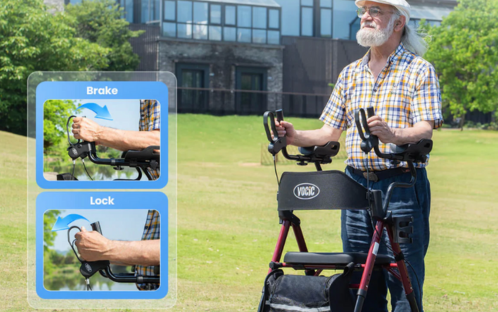
A standard rollator with adjustable handles may be useful for people who need walking support but still prefer a conventional handgrip position. The VOCIC Z21 Lightweight Rollator Walker has adjustable handles, allowing the grip position to be adapted to the user rather than requiring them to bend forward to reach a fixed height. It also includes a seat, which provides a place to rest if fatigue begins to affect walking posture. VOCIC describes the adjustable handle height as a feature intended to support a more upright walking position.
Some users who already require more upper-body support may prefer an upright rollator. The VOCIC Z22 Upright Rollator with Adjustable Armrests supports the forearms at a higher position than a conventional rollator, which may make it easier for some users to walk closer to the frame without leaning as far forward. Its adjustable armrests allow the support position to be adapted to the user.
The right setup still depends on the individual, whether the device comes from VOCIC or another provider. The shoulders should remain relaxed, the arms should feel comfortably supported, and the mobility aid should not force the user to reach forward or downward.
A rollator can support a more comfortable walking position when properly adjusted, but it is a mobility aid rather than a device for correcting kyphosis or another structural spinal curve. People comparing different styles of walking support can consider whether conventional or upright rollator walkers provide the most appropriate handle position, forearm support, braking control, and opportunity to rest.
During Lifting and Household Tasks
Household activities such as laundry, gardening, cleaning, or picking objects up from the floor can involve repeated forward bending.
Move closer to the object before lifting, bend through your hips and knees when appropriate, and keep the load close to your body as you rise.
For tasks performed close to the floor, raising the working height or sitting on a stable surface can also reduce the amount of time spent bent forward.
Why Does My Back Keep Hunching Forward?
You may be able to straighten yourself temporarily but notice that you gradually return to a rounded position. This often means that more than conscious effort is involved.
Long Periods of Sitting
Sitting for hours can encourage the head and shoulders to move forward, particularly when your screen or work surface is poorly positioned.
Rather than trying to maintain one perfect sitting position all day, adjust your setup and change positions regularly.
Tight Chest and Shoulder Muscles
If the muscles across the front of your chest and shoulders feel tight, moving into an upright position may be harder.
Gentle stretching and mobility work can make the position easier to reach without forcing the shoulders backward.
Limited Core and Upper-Back Strength
Your abdominal, back, shoulder, hip, and pelvic muscles all contribute to supporting your trunk.
If these muscles fatigue quickly, maintaining an upright position can become more difficult even if you know how you want to stand.
Fatigue and Reduced Mobility
A person may lean forward more when walking becomes physically demanding.
This can be particularly noticeable in older adults or people with reduced leg strength, balance, or endurance. Because balance problems in seniors may have several causes, persistent instability should not automatically be treated as a posture problem. Rest breaks, appropriate activity, and properly adjusted walking support may help reduce unnecessary forward leaning.
Changes in the Spine With Age
Posture can also change because of conditions affecting the bones, joints, or spine.
Osteoporosis, arthritis, spinal injuries, and some forms of kyphosis may contribute to a more rounded upper back. These changes cannot always be addressed through posture exercises alone.
When a Rounded Back Needs More Than Posture Changes
Not every rounded back comes from posture habits. Bone health, spinal structure, pain, muscle weakness, and neurological conditions can also affect how a person stands and walks.
Consider speaking with a doctor or physical therapist if:
- Your upper back is becoming progressively more rounded.
- The curve remains pronounced when you try to stand upright.
- You have persistent or severe back pain.
- You develop numbness, tingling, or weakness.
- Walking or balance is becoming more difficult.
- The posture change started after an injury.
- You have breathing difficulty alongside a pronounced spinal curve.
There is also no universal timeline for “fixing” posture. You may look more upright as soon as you change position, while improving strength, mobility, endurance, and long-standing movement habits takes regular practice.
Progress can depend on how much time you spend sitting, your activity level, your current mobility, and whether a health condition is affecting the spine.
Conclusion
To straighten your back, focus on comfortable alignment rather than forcing the spine into a rigid position. Better sitting, standing, walking, and screen habits, combined with mobility and strengthening exercises, can make an upright posture easier to maintain. A fixed curve or worsening pain, weakness, numbness, or balance problems should be professionally assessed.
FAQ
Can You Actually Straighten Your Back?
You can often improve a slouched or rounded posture by changing your alignment, increasing mobility, and strengthening the muscles that support your trunk. However, the spine naturally has curves, and structural spinal conditions cannot always be straightened through exercise.
Can a Hunched Back Be Corrected?
It depends on the cause. A hunched appearance related mainly to posture may improve with exercise and changes to daily habits. A fixed spinal curve may require professional evaluation and may not be correctable with posture exercises alone.
What Exercise Helps Straighten Your Back?
Chin tucks, chest stretches, wall angels, bridges, and bird dogs can help improve the mobility, strength, and control involved in maintaining upright posture. The most suitable exercises depend on your current mobility and any existing health conditions.
How Can I Straighten My Back While Sitting?
Keep your feet supported, use the chair to support your back, position your screen so you do not need to lean forward, and keep frequently used items close. Change positions regularly instead of trying to hold one rigid sitting posture for long periods.
How Long Does It Take to Fix Poor Posture?
There is no fixed timeline. You can change your position immediately, but improving strength, mobility, endurance, and long-standing posture habits generally takes consistent practice over time.
Does Sleeping on Your Back Improve Posture?
Sleeping on your back may be comfortable for some people, but sleep position alone is unlikely to correct poor posture. Daytime sitting, standing, movement habits, mobility, and muscle strength generally have a greater influence on how you hold your body while awake.

Share:
How to Plan and Pay for Long-Term Care Without Stress
How to Measure for a Wheelchair: A Complete Sizing Guide