
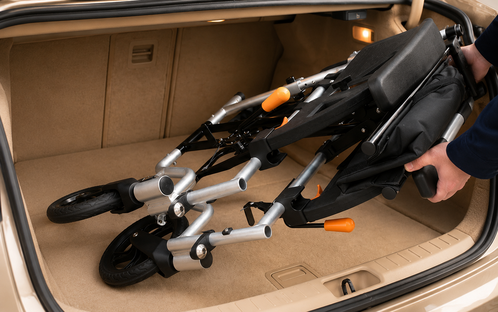
Learning how to fold a wheelchair is usually straightforward once you identify its frame and folding mechanism. For a standard cross-brace manual wheelchair, lock the brakes, clear the seat, move the footrests out of the way, and pull upward from the center of the seat. Electric and rigid-frame wheelchairs require different steps, so always check the model’s manual before applying force.
The wheelchair should be empty before you begin. If someone is seated, complete a safe transfer first and make sure they are stable before handling the chair.
How to Fold a Manual Wheelchair in 6 Simple Steps
To fold a standard manual wheelchair, park it on level ground, lock the brakes, remove the seat cushion, fold or swing away the footrests, stand beside the chair, and pull upward from the center of the seat. Confirm that the frame is fully collapsed before lifting it.
These steps apply mainly to manual wheelchairs with an X-shaped cross-brace beneath the seat.
Step 1: Park the Wheelchair on Level Ground
Move the wheelchair onto a firm, level surface where you have enough space to stand beside it. Avoid folding it on a slope, wet pavement, or uneven ground because the chair may shift unexpectedly.
Remove the seat cushion, shopping bags, blankets, and anything stored under or behind the seat. A strap or bag caught in the frame can prevent the chair from closing and may become damaged if you continue pulling.
Step 2: Lock the Brakes
Engage both wheel locks so the chair does not roll while you handle the seat. Wheel-lock levers are commonly located near the rear wheels, although their exact position varies by model.
Wheel locks stabilize an empty chair during folding. They are not a substitute for completing a safe transfer before the process begins.
Step 3: Fold Up or Remove the Footrests
Move both footplates out of the folding path. Depending on their design, they may flip upward, swing to the sides, or detach from the frame.
Do not pull aggressively if a footrest does not move. Look for a release lever or button and consult the manual. Forcing a fixed component can bend its mounting hardware.
Step 4: Stand Beside the Wheelchair
Stand next to the chair rather than directly in front of it. Keep your feet away from the casters and folding frame so they are not caught as the sides move inward.
Before touching the seat, locate the cross-brace and hinge points. Keep your fingers outside these areas throughout the process.
Step 5: Pull Up from the Center of the Seat
Hold the front and rear portions of the seat upholstery and lift them upward together. On a conventional folding frame, this releases tension across the seat and draws the two sides toward each other.
Lift slowly and allow the frame to collapse naturally. Do not place your fingers around the seat rails or between the cross-brace bars. If the chair stops partway, lower it and check for a trapped belt, cushion, or footrest instead of pulling harder.
Chair weight becomes important after the frame closes. The VOCIC U32 Ultra Lightweight Manual Wheelchair weighs 35 pounds and has a compact folding design. Its lower weight may make closet storage and car loading more manageable for some caregivers, although every person should assess what they can lift safely.
Step 6: Check That the Chair Is Fully Folded
Confirm that the sides are evenly collapsed and that no upholstery, cables, or accessories are trapped in the frame. If the wheelchair has a transport latch, folding strap, or locking clip, secure it before lifting.
Collect removable footrests and cushions separately. Leaving them loose can damage the chair or vehicle and make smaller parts easier to lose.
The lift-the-seat method is common, but it is not universal. Identifying the frame is the next essential step.

Do All Wheelchairs Fold the Same Way?
No. Manual, transport, rigid-frame, and powered wheelchairs can use very different mechanisms.
|
Wheelchair type |
Typical folding method |
Parts that may need attention |
Main precaution |
|
Cross-brace manual wheelchair |
Lift the seat so the sides move inward |
Cushion and footrests |
Keep fingers away from seat rails and braces |
|
Transport wheelchair |
Often folds at the seat; the backrest may also collapse |
Footrests and backrest |
Confirm all release levers relock |
|
Rigid-frame wheelchair |
May have a folding back and removable rear wheels |
Wheels, backrest, and cushion |
Do not try to collapse the fixed frame |
|
Folding power wheelchair |
Uses a handle, pin, latch, or hinged frame |
Battery, joystick, and footrest |
Turn off the power and follow the manual |
The right design depends on whether the user needs self-propulsion, caregiver assistance, powered mobility, or a lightweight chair for frequent transport. Comparing different wheelchairs can make the differences in frame design, portability, and daily operation easier to understand.
An X-shaped brace beneath a flexible seat usually indicates a conventional folding manual frame. A fixed seat pan and solid side structure may indicate a rigid chair. Powered models commonly have wiring, a battery, and a dedicated folding release.
If you cannot identify the mechanism, find the model label and consult its manual before proceeding.
How to Fold an Electric Wheelchair
Electric wheelchairs should not be folded by copying the steps for a manual chair. Their batteries, controllers, cables, and locking systems require additional preparation.
Turn Off the Power and Engage the Brakes
Bring the wheelchair to a complete stop and switch off the controller. Check whether the drive levers must remain in electric mode or move into a designated transport position.
Never operate a powered folding mechanism while someone is seated unless the manufacturer has specifically designed and approved it for that purpose.
Secure or Remove the Battery as Directed
Some electric wheelchairs fold with the battery installed, while others recommend removing it before transport. Battery removal may also reduce the weight that needs to be lifted.
Follow the instructions for disconnecting and carrying the battery. Do not pull on cables, touch exposed contacts with metal objects, or allow a loose battery to slide around inside a vehicle.
Fold the Footrest and Protect the Joystick
Raise or fold the footrest according to the product instructions. If the joystick swivels inward or detaches, place it in its transport position.
The joystick can extend beyond the folded frame and may be damaged by a doorway or trunk lid. Keep its cable relaxed rather than sharply bent.
Release the Folding Lock or Safety Pin
Find the folding handle, latch, or safety pin identified in the manual. Steady the frame with one hand while releasing the mechanism with the other.
The VOCIC V62 Foldable Dual-batteries Power Wheelchair illustrates this type of design. Its folding process involves standing behind the chair, locating the folding handle, steadying the armrest, and releasing the handle pin. It is designed to fold in about three seconds, but that sequence and speed are specific to this model.
Fold the Frame and Check the Lock
Guide the frame as it closes instead of allowing it to drop. Confirm that the backrest, footrest, battery, and controller remain secure and that no cables are pinched.
If the frame resists movement after the correct release has been operated, stop. A second latch may still be engaged, or another component may be obstructing the hinge.
Once folded, the chair must also be opened and checked correctly before anyone uses it again.

How to Unfold a Wheelchair and Make Sure It Is Safe
Place the folded chair on firm, level ground. Keep your hands away from the hinges and open the two sides enough to control the frame.
For a cross-brace manual wheelchair, press downward on the seat rails using the flats of your hands. Do not wrap your fingers around the rails because they can be pinched as the seat drops into position. Continue until the seat is flat and both rails are seated in their supports.
For a powered model, reverse the manufacturer’s folding sequence and confirm that every locking pin or latch engages. Reposition the joystick, footrest, and battery as instructed before switching on the controller.
Before anyone sits down, confirm that the frame and backrest are locked open. Test both wheel locks, make sure the armrests and footrests are secure, and inspect the seat upholstery and safety belt. No cable or fabric should be trapped in a hinge.
If any component feels loose, keep the chair unoccupied until the problem has been corrected.
Why Won’t My Wheelchair Fold?
A wheelchair that stops halfway usually has an obstruction or an engaged lock. Start by removing the cushion and checking for bags, belts, blankets, or upholstery caught beneath the seat.
Next, inspect the footrests. Even a partially rotated footrest can interfere with the frame. On powered models, confirm that you have released the correct pin or latch and positioned the backrest as directed.
Dirt or small objects can also lodge in the cross-brace or seat rails. Remove visible debris without reaching between loaded hinges.
Stop troubleshooting if the frame is bent, the folding pin is misaligned, a cable looks damaged, or the hinge remains jammed. Do not step on the frame, pry it open with tools, or remove safety hardware. A qualified mobility-equipment technician should inspect it.
If the chair is a VOCIC model, VOCIC provides access to product information and support for identifying the correct manual or replacement component. Instructions written for a different wheelchair should not be used to force or modify the folding mechanism.
After the wheelchair closes normally, consider how you will lift and store it without injuring yourself or damaging the chair.
How to Lift and Store a Folded Wheelchair
Lift a folded wheelchair from solid, fixed sections of its frame. Do not lift it solely by removable armrests, footrests, a joystick, or loose upholstery.
Check the total weight before attempting to load it into a vehicle. Folding reduces size, but it does not necessarily make a wheelchair light. A powered chair may still require two people, a ramp, or a vehicle hoist.
When lifting weight is the main obstacle, frame material can make a practical difference. The VOCIC V81 Ultra-Light Carbon Fiber Power Wheelchair weighs 46 pounds and has a foldable carbon-fiber frame. That may be easier to manage than many heavier powered chairs, but 46 pounds can still be too much for someone with limited balance, grip strength, or shoulder mobility.
Before buying or transporting any chair, measure its folded width, height, and length as well as the vehicle’s trunk opening. Open-chair measurements matter too, because standard wheelchair dimensions affect seat fit, doorway clearance, and everyday maneuverability. A chair may fit inside the cargo area yet still be too tall or awkward to pass through the opening.
Inside the vehicle, secure the chair and its removable components so they cannot move during a sudden stop. At home, store it in a dry, stable location away from extreme temperatures. Follow the battery manufacturer’s charging and storage instructions for powered models.
FAQ
Can you fold a wheelchair with the footrests attached?
Sometimes. Flip-up footplates may remain attached, while swing-away or detachable assemblies may need to be moved or removed. Follow the instructions for the specific chair.
Can one person fold and lift a wheelchair?
Many wheelchairs can be folded by one person, but lifting is a separate task. Consider the chair’s total weight, your strength and balance, and the height of the vehicle. Use assistance or lifting equipment when needed.
Should you remove the battery before folding a power wheelchair?
Only if the manual recommends or requires it. Removing the battery can reduce lifting weight, but the safe disconnection procedure varies between models.
Why does my wheelchair open after I fold it?
Its transport latch, folding clip, or securing strap may not be engaged. Inspect the locking component for damage and follow the manual. Avoid improvised straps that could crush cables or obstruct the frame.
Can you take a foldable electric wheelchair on an airplane?
Possibly, but being foldable does not automatically make a wheelchair acceptable for air travel. Because airline requirements for electric wheelchairs vary by carrier, battery type, and destination, contact the airline before departure and provide the battery rating, chair dimensions, and removal instructions it requests.
Fold the Right Wheelchair the Right Way
Safe folding starts with identifying the wheelchair rather than assuming every chair works alike. Clear the seat, move detachable components, protect your fingers, and operate only the intended release mechanism. If the chair resists, stop and look for an obstruction instead of forcing it.
When choosing a wheelchair for regular travel, compare its folding method, total lifting weight, folded dimensions, and battery requirements. A chair that matches both the user’s mobility needs and the caregiver’s transport capabilities will be easier and safer to manage.
If a wheelchair does not match the user’s current balance, endurance, or level of caregiver support, other mobility aids for seniors may provide a more suitable level of assistance.



Share:
Bathroom Safety for Elderly: How to Make a Bathroom Safer
How to Transfer from a Wheelchair to a Car Seat Safely