
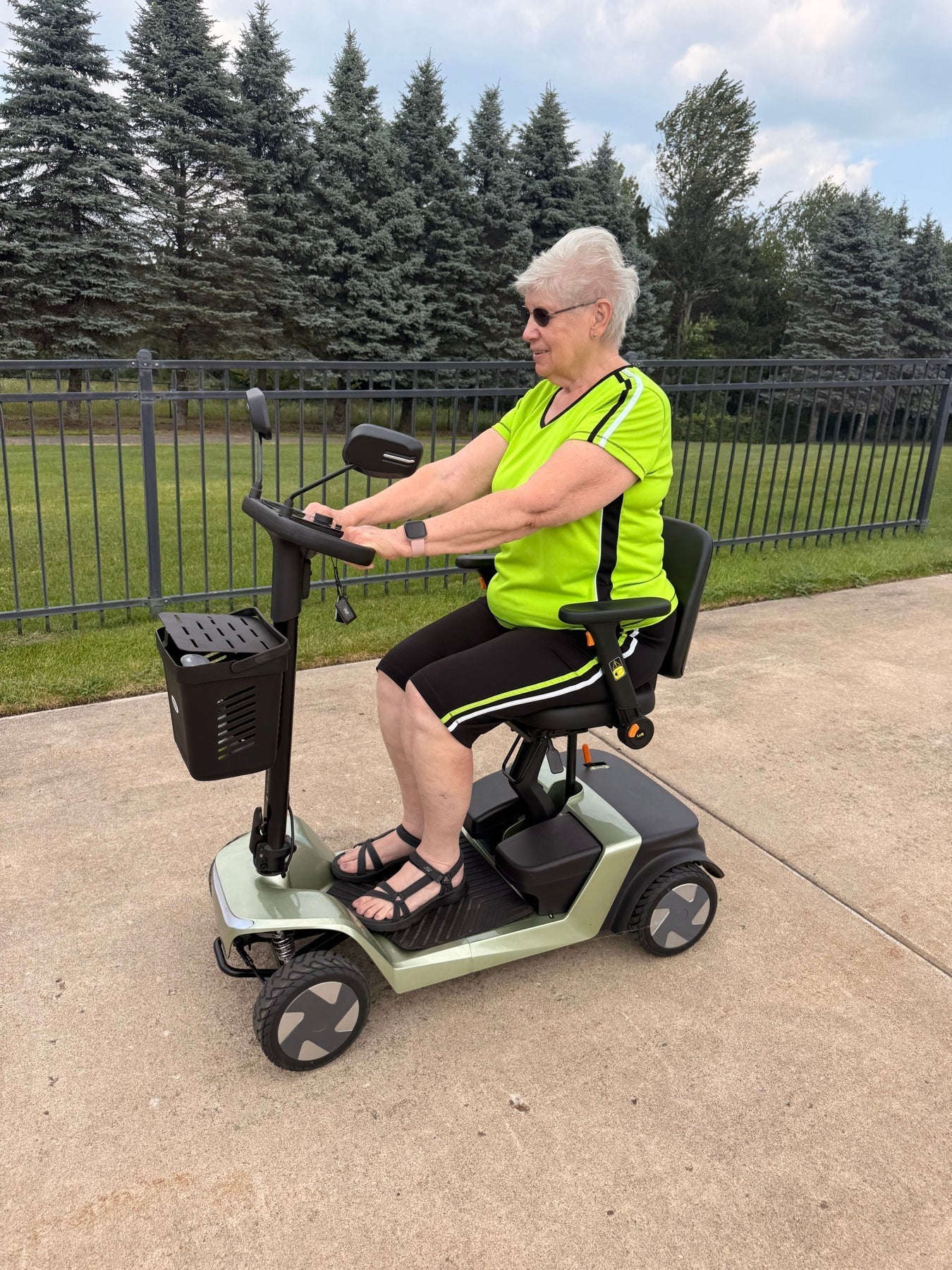
From an occupational therapy perspective, mobility scooters are more than transportation devices—they are essential tools for enabling participation in meaningful daily activities. As technology evolves, safety design must move beyond basic mechanical features and toward intelligent, user-centered systems that support physical, cognitive, and sensory needs. Modern innovations such as AI-powered differential systems and sensing seats represent a promising shift toward proactive, adaptive safety.
Traditional mobility scooter safety has focused on foundational elements like braking systems, anti-tip mechanisms, and stability control. These remain critical, as effective braking and stability engineering directly reduce the risk of falls and collisions in real-world environments . However, from a clinical standpoint, these passive safety features do not fully address the dynamic and individualized challenges many users face, such as impaired reaction time, fatigue, or postural instability.
An AI-powered differential system introduces a significant advancement in mobility control. Differential systems govern how power is distributed between wheels, directly impacting turning radius, maneuverability, and stability. With the integration of artificial intelligence, these systems can adapt in real time to environmental and user-specific conditions. For example, AI models can process data from terrain, speed, and user input to optimize turning precision and reduce abrupt or unsafe movements. Research in intelligent mobility systems highlights how data-driven control methods and machine learning can enhance navigation and responsiveness, ultimately improving safety and user confidence. For occupational therapists, this translates into improved functional mobility in tight indoor spaces and complex community environments, where precise control is essential.

Equally transformative is the concept of a sensing seat, particularly when designed with active safety logic in mind. A key feature of this system is its ability to power the scooter on only when the user is properly seated, and automatically turn the system off when the driver stands up. From an occupational therapy perspective, this seemingly simple function addresses a critical safety gap—preventing unintended movement when the user is not in a stable, seated position. Many scooter-related incidents occur during transfers on or off the device, when balance is compromised and accidental throttle activation can lead to falls or collisions.
By ensuring the scooter is only operable when the user is securely seated, the sensing seat acts as a built-in safeguard against these risks. The automatic shut-off feature when weight is removed adds an additional layer of protection, particularly for individuals with decreased balance, coordination challenges, or cognitive impairments. This design supports safer transfers, reduces caregiver concern, and promotes greater confidence for the user. In essence, the sensing seat shifts safety from reactive to preventative—aligning closely with occupational therapy’s focus on minimizing risk before injury occurs.

Brands such as VOCIC Medical are beginning to reflect this shift toward intelligent, user-centered design in mobility solutions. By incorporating advanced technologies into their scooters, they contribute to a broader movement in assistive technology—one that prioritizes not only independence, but also real-time safety and adaptability.

In conclusion, the future of mobility scooter safety lies in the integration of intelligent systems that actively support the user. AI-powered differential systems enhance environmental navigation and control, while sensing seats provide crucial safeguards that prevent unintended operation. Together, these innovations align closely with occupational therapy goals: promoting independence, reducing risk, and enabling individuals to engage safely and confidently in daily life.
Share:
D62 - Mobility Made Stronger
Choosing the Right Mobility Aid to Reduce Joint Pain