
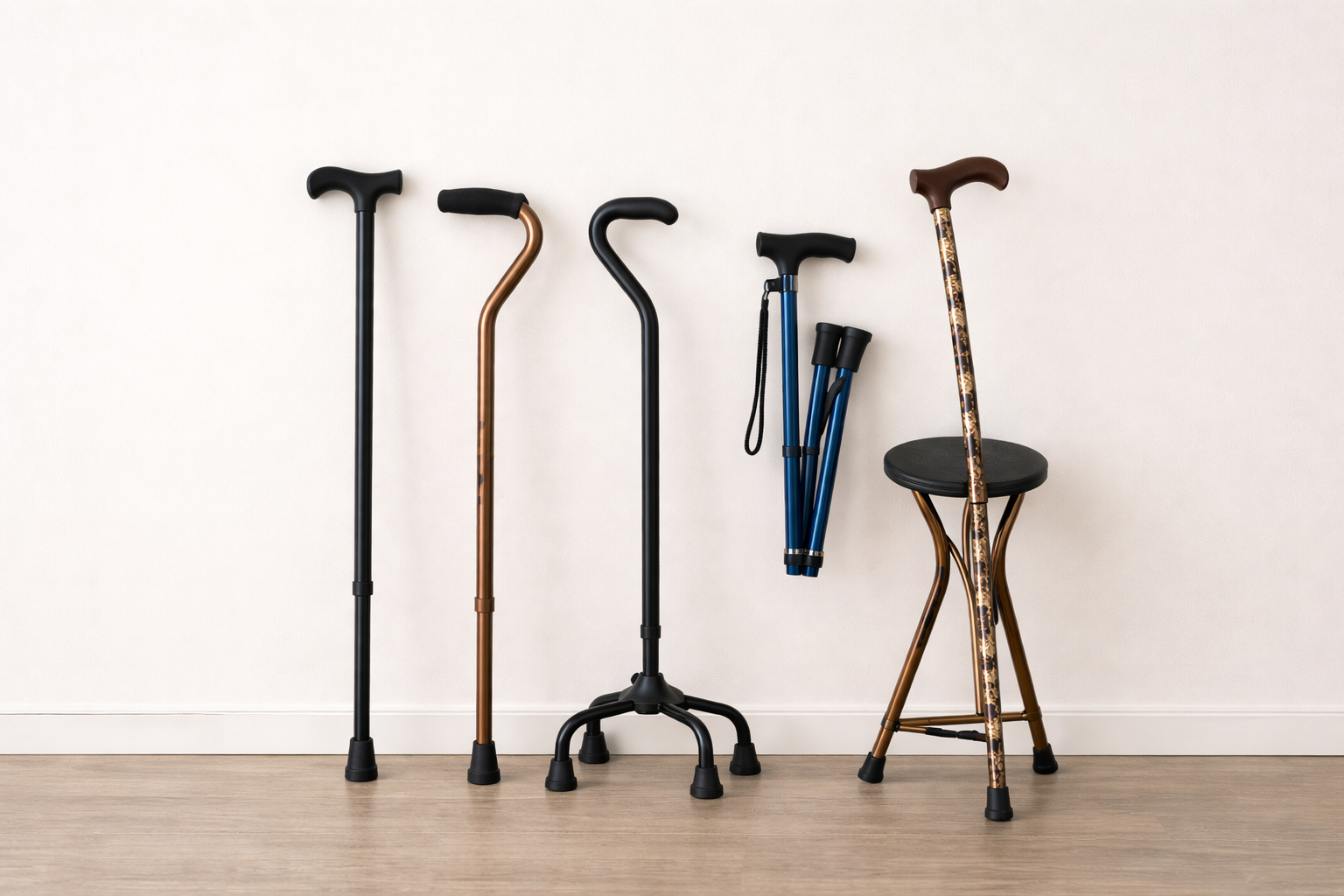
A walking cane can improve balance, reduce strain, and make daily movement feel safer, but different types of canes are designed for different support needs. Understanding how each type works is the key to choosing one that actually fits the way a person walks.
What Is a Walking Cane and What Does It Help With
A walking cane is designed to provide extra balance support and reduce strain during walking, especially for people with mild to moderate mobility challenges.
A cane does not fully carry a person’s weight the way some larger mobility aids can. Its main job is to add one extra point of contact with the ground, which can help improve stability and make walking feel more controlled. When choosing between a walker and a cane, the decision usually depends on how much stability and daily support a person needs.
For many users, that small amount of help makes a noticeable difference. A cane may help with:
- mild balance problems
- slight weakness on one side
- joint discomfort in the hip, knee, or ankle
- recovery after surgery or injury
- walking with confidence in busy or uneven spaces
That said, not every cane works the same way. Some are built for light everyday support. Others offer a wider base and more stability. Some fold for travel. Some include a seat for short rests. The best choice depends less on appearance and more on how much support the user actually needs.
Main Types of Canes and How They Differ
The main types of canes differ in stability, weight, portability, and the kind of walking support they are built to provide.
A quick comparison makes the differences easier to see:
|
Type of Cane |
Best For |
Main Benefit |
Main Limitation |
|
Standard cane |
Mild balance support |
Lightweight and simple |
Least stable option |
|
Quad cane |
Users who need more stability |
Wider base, stands more securely |
Heavier and less fluid to use |
|
Offset cane |
Users needing better weight distribution |
More supportive design |
Still limited for more serious instability |
|
Folding cane |
Travel or backup use |
Easy to store and carry |
May not feel as solid for heavy daily use |
|
Seat cane |
Users who tire easily outdoors |
Offers a place to rest |
Bulkier and not ideal for everyone |
Standard Canes
A standard cane is the simplest type of walking cane and is usually best for mild support needs.
This is the classic single-tip cane many people picture first. It is usually lightweight, easy to carry, and fairly straightforward to use. For someone who only needs a little extra balance help, a standard cane may be enough.
It often works well for indoor walking, short outings, and day-to-day movement when the user is mostly steady but wants a bit more confidence. It can also be a practical temporary aid during recovery.
Its biggest advantage is simplicity. Standard canes are often easier to lift, easier to store, and less visually bulky than other options.
Its biggest drawback is also simple: it provides the least support. If a person is already showing noticeable instability, a standard cane may not offer enough help to make walking truly safer.
Quad Canes
A quad cane offers more stability than a standard cane because it has a broader base with four points touching the ground.
Quad canes are often recommended for users who need more support than a single-tip cane can provide. Because the base is wider, the cane tends to feel steadier, especially when the user pauses or shifts weight slowly.
This makes quad canes a common option for people with more noticeable weakness, reduced balance, or limited confidence while walking. Some users also like that many quad canes can stand on their own when not in use.
The tradeoff is that they are usually heavier and less smooth to move with each step. They can feel a bit clunky, especially in tight indoor spaces or for users who still walk at a fairly natural pace. More stability is useful, but it can also mean less convenience.
Offset Canes
An offset cane is designed to place the user’s weight more directly over the shaft, which can improve support and control.
This type is easy to recognize because the handle curves forward rather than sitting directly on top of the shaft. That shape is not just for looks. It helps distribute pressure more efficiently and is often considered a better choice for people who need regular weight-bearing support.
Offset canes can be a good middle ground. They often feel more supportive than a very basic straight cane, while still staying slimmer and easier to manage than a quad cane.
For users with mild to moderate support needs, especially those dealing with one-sided weakness or discomfort during longer walks, this style can feel more stable without becoming too bulky.
Folding Canes
A folding cane is designed for convenience and portability, making it a popular option for travel or occasional use.
These canes collapse into smaller sections, which makes them easier to pack in a bag, store in a car, or carry as a backup when needed. That portability is the main reason people choose them.
A folding cane can work well for users who do not need support all the time but want something available for longer outings, airports, events, or days when walking feels more tiring than usual.
Still, portability should not be the only factor. Some folding canes feel very sturdy, but in general, frequent daily users often care more about a secure feel than compact storage. If someone relies on a cane for most of the day, stability and fit matter more than whether it folds neatly.
Seat Canes
A seat cane combines walking support with a built-in seat, which can help users who need to stop and rest during outings.
This type is often considered by people who can still walk but tire easily in outdoor settings. Waiting in lines, walking through large stores, attending events, or moving through parks can all become more manageable when there is a built-in place to sit for a moment.
That convenience can be helpful, but seat canes are not ideal for everyone. They are usually bulkier than regular canes, and the support they provide while walking may not match the comfort or stability of other mobility aids designed for longer use.
They make the most sense for users whose main problem is endurance rather than serious instability.

How to Choose the Right Type of Cane
The right cane should match the user’s balance needs, walking environment, comfort level, and body fit. Choosing a cane is not only about picking a type. It is about matching the tool to real-life use. A few key questions usually matter most.
Consider Your Level of Balance Support
Start with the most important question: how much support is actually needed?
Someone with mild unsteadiness may do well with a standard or offset cane. Someone who feels shaky when standing still, turning, or walking on uneven ground may need the broader base of a quad cane instead.
This is where many people choose poorly. They assume the lightest or least noticeable cane is automatically best. In practice, the best cane is the one that makes walking feel safer and more controlled.
Think About Where You Use It Most
A cane used mainly at home may not need the same features as one used outdoors every day.
For example:
- indoor users may prioritize maneuverability
- outdoor users may care more about stability on uneven ground
- travelers may prefer a folding design
- users who tire easily during errands may want seating support
A cane that works fine in a hallway may feel very different on sidewalks, ramps, parking lots, or crowded public spaces.
Check Handle Style and Comfort
Handle comfort matters more than people expect. If the grip feels awkward, too narrow, or hard on the hand, the cane becomes tiring to use.
This is especially important for people with arthritis, hand weakness, or limited grip strength. A supportive handle shape can reduce pressure and make the cane easier to use for longer periods.
Make Sure the Height Is Correct
A cane that is the wrong height can affect posture, reduce support, and make walking less safe.
A properly fitted cane allows the user to stand naturally with a slight bend in the elbow while holding the handle. If the cane is too short, the user may lean too much. If it is too tall, the shoulder and arm position may feel unnatural.
Even a well-designed cane will not help much if the fit is off. Height adjustment is not a minor detail. It is part of safe use.
When a Cane May Not Be Enough Support
If walking feels increasingly unsteady or tiring, a cane may no longer provide enough support. A cane can help with mild balance issues, but it may not be the best fit once a person starts needing more stability, more frequent rest breaks, or more support during longer outings. That is often when a rollator walkermakes more sense.
For users who want steadier walking support without giving up flexibility, theVOCIC Z51 Shift Combo 2 In 1 Rollator - Transport Chair Walker can be a practical step up. It works as a rollator for everyday walking support and can also convert into a transport chair, which is especially helpful when endurance becomes part of the issue, not just balance.
Choosing more support is not about losing independence. In many cases, it is what helps people stay active and move with more confidence.

Common Mistakes People Make When Choosing a Cane
Most cane mistakes happen when people focus on convenience or appearance before support and fit. A cane should make walking easier. When it does not, the issue is often not the idea of using a cane itself, but the specific choice.
Common mistakes include:
- choosing the lightest cane without considering stability
- buying a folding cane for full-time daily use without checking how solid it feels
- using the wrong height
- picking a cane based on looks alone
- continuing to use a cane when walking needs have clearly progressed beyond it
Another common mistake is assuming one cane style works for everyone. It does not. A person with slight balance loss has very different needs from someone recovering from surgery or dealing with more advanced weakness.
Conclusion
Different types of canes serve different purposes. Standard canes work best for light balance support, while quad canes offer more stability, and offset canes can provide better weight distribution. For users comparing different options, looking at the best walking aids for balance can also help put canes in context alongside other mobility support choices. Folding canes are useful for portability, and seat canes may help users who tire easily during outings. The right choice depends on how much support is needed, where the cane will be used, and whether a cane still provides enough help for safe, comfortable walking.
FAQ
What type of cane is best for balance?
A quad cane is often better for balance because its wider base provides more stability than a standard single-tip cane. For milder balance concerns, an offset cane may also work well.
What is the difference between a standard cane and a quad cane?
A standard cane has one tip and is lighter and simpler to use. A quad cane has a four-point base, which makes it more stable but also heavier and less fluid for some users.
Are folding canes good for everyday use?
They can be, but that depends on the user. Folding canes are especially useful for travel or occasional support. For heavy daily use, many people prefer a cane that feels more solid and stable.
How do I know if I need a cane or a walker?
A cane is generally better for mild to moderate support needs. If walking feels unsafe, fatigue is significant, or more stability is needed from both sides, a walker may be a better option.
What height should a walking cane be?
A walking cane should be adjusted so the user can stand upright with a slight bend in the elbow while holding the handle. Correct height helps improve posture, comfort, and safety.
Share:
Steps Per Day Goal by Age: How Many Steps Should You Aim For?
When Is the Best Time to Exercise? Morning vs. Afternoon vs. Evening