
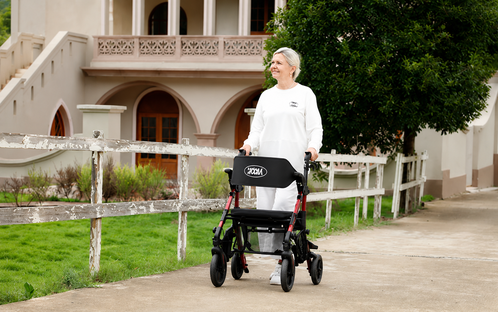
Choosing between a rollator and a standard walker depends on how much support the user needs, how safely they can control the device, and where they plan to use it most often. A rollator works better for users who can walk independently but need help with balance, endurance, and short rest breaks. A standard walker is usually better for users who need stronger support with each step, especially during recovery or slower indoor movement.
Both devices can improve mobility, but they support different needs. This guide explains the key differences, when to choose each one, and what to consider before buying a walking aid.
Quick Answer: Rollator vs Standard Walker
Among different types of walkers, a rollator walker has wheels, hand brakes, and often a built-in seat. It moves smoothly without being lifted, so it is easier for longer walks, errands, and outdoor use. However, the user must be able to control the wheels and brakes safely.
A standard walker has a simple four-leg frame without continuous rolling movement. The user lifts and places it forward with each step. This makes it slower, but it can offer more stable support for people who need to lean on the walker more heavily.
|
Feature |
Rollator |
Standard Walker |
Better Choice If... |
|
Movement |
Rolls forward on wheels |
Must be lifted and placed |
Rollator for smoother walking; standard walker for slower, controlled steps |
|
Support Level |
Balance and endurance support |
Stronger weight-bearing support |
Standard walker for stronger step-by-step support |
|
Seat |
Usually included |
Usually not included |
Choose a rollator if you need rest breaks |
|
Brakes |
Hand brakes required |
No hand brakes on basic models |
Choose a rollator only if you can control brakes safely |
|
Indoor Use |
Works if space allows |
Good for tight indoor areas |
Choose a standard walker for narrow rooms and slower indoor movement |
|
Outdoor Use |
Better for longer walks and smooth outdoor paths |
Less convenient outdoors |
Choose a rollator for errands, sidewalks, and community outings |
|
Portability |
Often foldable but may be bulkier |
Usually lighter and slimmer when folded |
Choose based on car storage, lifting ability, and daily routine |
What Is a Rollator Walker?
A rollator walker is a wheeled walking aid, usually with three or four wheels, hand grips, hand brakes, and a frame that rolls forward as the user walks. Many rollators also include a built-in seat, backrest, and storage bag or basket.
A rollator is designed to move smoothly without being lifted. The wheels help users keep a more natural walking rhythm, while the built-in seat gives them a place to rest when the rollator is stopped and the brakes are locked.
The main safety requirement is control. A rollator should only be used by someone who can steer it, slow it down, lock the brakes, and sit safely when the rollator is stopped.
What Is a Standard Walker?
A standard walker is a basic walking aid with a stable frame and four legs. It usually does not have wheels, a seat, or hand brakes. The user lifts the walker, places it forward, and then steps into it.
This slower movement can be helpful for people who need more support, such as users recovering from surgery, users with weaker balance, or people who need a stable frame before taking each step. A standard walker can also work well indoors because it does not roll forward unexpectedly.
The tradeoff is effort. Since the user needs to lift and move it repeatedly, a standard walker may feel tiring for longer distances or for users with limited upper body strength.

Rollator vs Standard Walker: Key Differences
The main differences come down to movement, support, safety control, and daily use. A rollator can make walking feel smoother, while a standard walker can provide more direct support for each step.
Mobility and Walking Speed
A rollator supports a more continuous walking rhythm. The user pushes it forward while walking, which can feel more natural than lifting a frame with each step. This makes rollators useful for people who walk longer distances, move around the community, or get tired when using a slower device.
A standard walker supports slower and more controlled movement. Each step takes more effort because the walker must be lifted and placed. This can be safer for users who need to pause often or who feel more secure with a stable frame in front of them.
Stability and Weight Support
A standard walker generally provides more direct support. Since all four legs contact the ground before the user steps forward, it can feel steadier for users who need to rely on the frame for balance or partial weight support.
A rollator provides balance support, but it is not meant for users who need to put most of their weight through the device. The wheels can move if the brakes are not controlled properly, so the user needs enough hand strength, coordination, and reaction time.
Seat, Brakes, and Storage
Rollators usually include a seat, hand brakes, and storage space, which can make longer outings and rest breaks easier. These features are useful, but they also require the user to understand how to stop, lock, and position the rollator safely.
Standard walkers are simpler. They usually do not include a seat or built-in storage, but the basic frame can be easier to manage for users who want fewer parts to adjust or maintain.
Indoor and Outdoor Use
A standard walker often works well indoors, especially in smaller homes, bedrooms, bathrooms, or narrow hallways. Since it does not roll forward freely, it may feel easier to control in tight spaces.
A rollator is often more practical for outdoor use, errands, and longer walking routes. The wheels make it easier to move across smooth sidewalks, clinics, shopping areas, and community spaces. For rougher outdoor surfaces, larger wheels and stronger braking control become more important.
Portability and Storage
Standard walkers are usually lighter and slimmer when folded, which can make them easy to store or transport. This is useful for users who need a basic walker for short indoor trips, temporary recovery, or simple car transport.
Rollators often take up more space because they include wheels, brakes, a seat, and sometimes a storage bag. Even when they fold, some models can still feel bulky when loading them into a car trunk, storing them beside a bed, or bringing them on a trip.
For users who want the smoother movement and resting support of a rollator but worry about portability, a compact folding rollator can be a better fit. The VOCIC Z35 PackGo is more relevant here because it is designed around travel and storage, with a lightweight frame and compact folding structure that makes it easier to carry, store, and transport than a traditional full-size rollator.
Cost and Maintenance
Standard walkers are usually more affordable because they have a simpler structure and fewer moving parts. They may also require less maintenance.
Rollators usually cost more because they include wheels, brakes, seats, backrests, and folding systems. The added features can improve independence, but users should check the brakes, wheels, seat, and frame regularly to keep the device safe. Replacement brake parts, worn wheels, and loose folding joints may also add maintenance needs over time.

When Should You Choose a Rollator?
A rollator may be a good choice if the user can walk independently but needs help with balance, endurance, or confidence. It is especially useful for people who get tired during errands, appointments, neighborhood walks, or social outings.
A rollator also works well for users who need a seat for short rest breaks. If someone can control hand brakes, turn safely, and walk at a steady pace, a rollator can support more natural movement than a standard walker.
For everyday use, a model such as the VOCIC Z21 can fit users who want a seated rollator for walking support, short rests, and routine indoor-outdoor movement. It is more appropriate for users who want rollator independence than for users who need heavy weight-bearing support.
When Should You Choose a Standard Walker?
A standard walker may be better if the user needs more stability with each step. This can apply after surgery, during injury recovery, or when the user has significant weakness, poor balance, or a higher fall risk.
It can also be a better option for short indoor movement. If the user mainly walks from the bed to the bathroom, around the kitchen, or through narrow rooms, the slower and more controlled movement of a standard walker may feel safer.
A standard walker may also be easier for users who cannot reliably operate hand brakes. Since a basic standard walker does not roll forward continuously, it may reduce the chance of the device moving away unexpectedly.
What About a Two-Wheel Walker?
A two-wheel walker, also called a front-wheeled walker, is a middle option between a standard walker and a rollator. It usually has wheels on the front legs and rubber tips or glides on the back legs.
This type can help users who find it hard to lift a standard walker but still need more control than a four-wheel rollator provides. The front wheels make it easier to move forward, while the rear legs help slow the walker and provide more stability.
A two-wheel walker may be worth considering if a standard walker feels too tiring but a rollator feels too fast or hard to control. If longer distances are the main challenge rather than step-by-step balance, a mobility scooter may be another option to consider. A doctor, physical therapist, or occupational therapist can help decide whether this middle option fits the user’s balance and support needs.
Safety Tips Before Using Either Walker
A walker or rollator should match the user’s height, strength, balance, and walking environment. The handles should allow the user to stand upright with a slight bend in the elbows. If the walker is too low or too high, it can affect posture and increase strain.
For rollators, using a rollator walker safely and effectively starts with checking the brakes before use. The user should know how to slow down, stop, and lock the brakes before sitting. The seat should only be used when the rollator is stopped, the brakes are locked, and the surface is flat and stable.
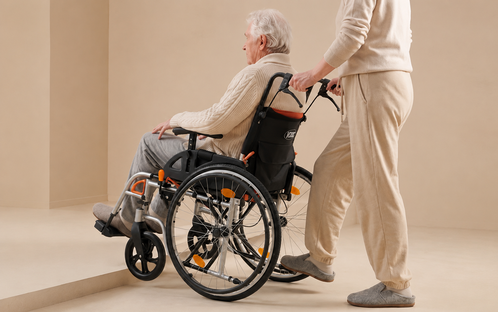
Not every rollator seat is designed for caregiver-assisted pushing. Many standard rollators are mainly intended for walking support and short seated rest breaks when the brakes are locked. If the user needs to sit while a family member or caregiver pushes them, look for a rollator that is specifically designed with transport chair or wheelchair mode.
For users who sometimes walk independently but also need caregiver-assisted seated movement, a 2-in-1 option such as the VOCIC Z51 can be more appropriate than a basic rollator. It is designed to switch between rollator walker and transport chair use, with footrests and seated support for safer assisted movement.
Conclusion
A rollator is usually better for users who can walk steadily, control hand brakes, and want smoother movement with a seat for rest breaks. A standard walker is usually better for users who need stronger step-by-step support, slower movement, or more stability during recovery or indoor use. If the choice is unclear, ask a doctor, physical therapist, or occupational therapist to match the walking aid to the user’s balance, strength, and daily environment.
FAQs
Which is safer, a rollator or a standard walker?
A standard walker can feel safer for users who need more support or move slowly indoors. A rollator can be safe for users who can control the wheels and brakes. Neither option is automatically safer for everyone. The right choice depends on the user’s condition and walking environment.
Can you sit on a rollator and be pushed?
No, a standard rollator should not be used like a wheelchair. The seat is for resting while the rollator is stopped and the brakes are locked. If the user needs to sit while someone pushes them, choose a transport chair or a 2-in-1 rollator transport chair designed for that purpose.
Should I choose a rollator or a two-wheel walker?
Choose a rollator if the user can walk steadily, control hand brakes, and wants smoother movement with a seat. Choose a two-wheel walker if a standard walker feels too tiring to lift but a rollator feels too fast or unstable. A healthcare professional can help decide which option is safer.
Can I use a rollator after surgery?
It depends on your recovery stage and how much support you need. Many people need a standard walker first because it provides more controlled support, while a rollator may be considered later if they can walk steadily and control the brakes safely.
Share:
How Often Will Medicare Replace a Rollator Walker?
Best All-Terrain Walkers for Seniors: Outdoor Rollator Picks and Buying Tips